

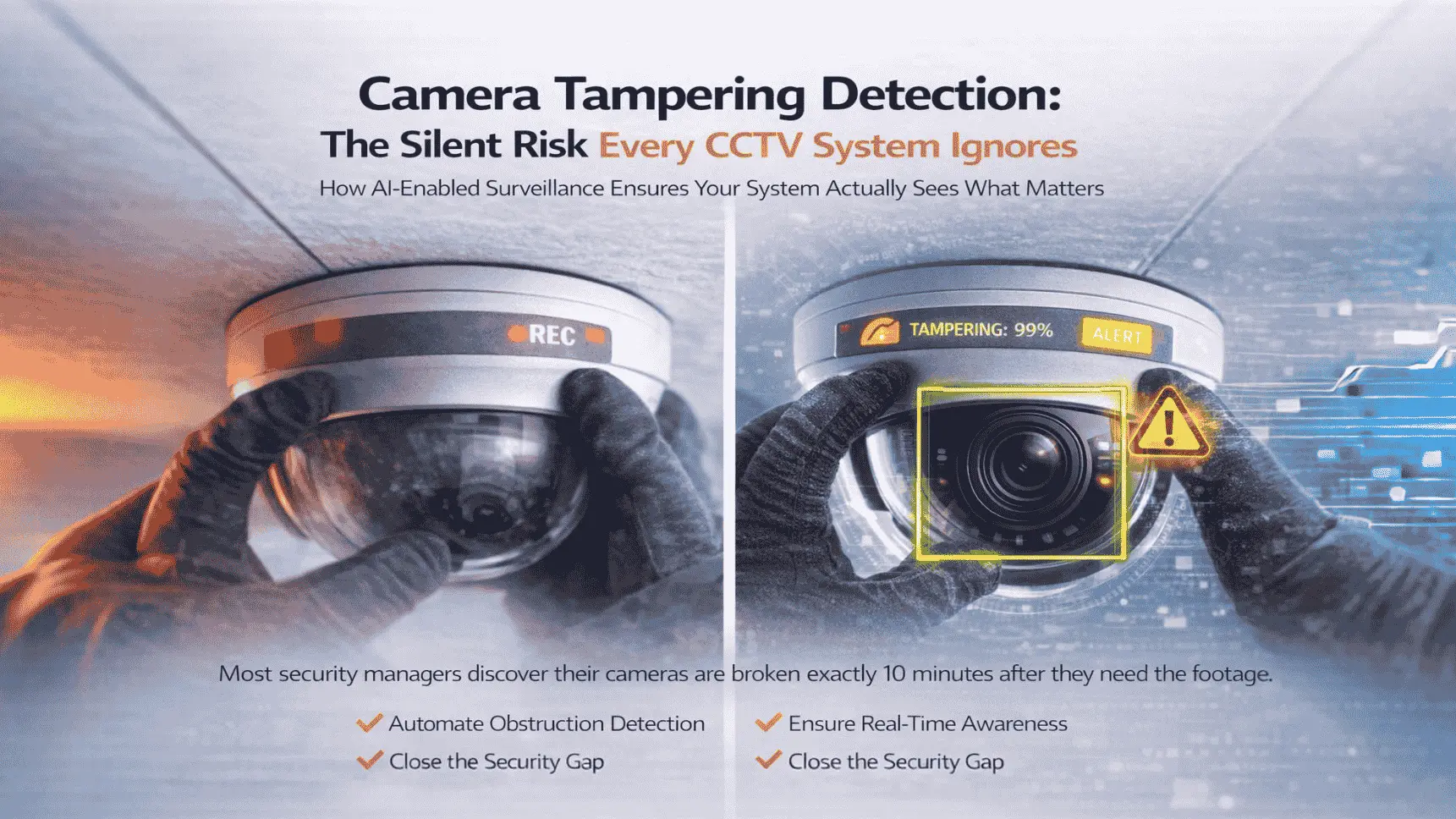
Most security managers discover their cameras are broken exactly 10 minutes after they need the footage.
You go to pull the video of an incident, a forklift collision, a theft, a safety breach and you don't find evidence. You find a black screen or a smudge of gray grease where a lens used to be focused or a pristine 4K view of a blank wall because the camera was knocked out of alignment three weeks ago.
The server room lights were green. The drives were writing data. The system looked healthy.
But the eyes were shut.
This is the most common failure in modern surveillance. We obsess over storage capacity and resolution, yet we ignore the only metric that actually counts: integrity.
If you aren't using camera tampering detection, you aren't running a security system. You’re running a very expensive placebo.
The "Set and Forget" Trap
We treat cameras like lightbulbs , if they have power, they work.
But in industrial environments, hardware is constantly under siege. It’s rarely a dramatic "spy movie" attack where someone cuts the cable. CCTV camera tampering is usually boring, gradual, and inevitable:
 The Slow Fade: Dust builds up on the lens until the image is opaque.
- The Accidental Block: A worker stacks a pallet too high, blinding a critical aisle.
- The Nudge: A cleaning crew bumps a dome camera, shifting its view by 10 degrees.
- The Drift: Vibration from heavy machinery slowly loosens the focus ring over months.
Without a system to flag these shifts, you are just recording terabytes of static.
Why Manual Checks Are a Myth
"We have guards. They check the feeds."
It’s a comforting lie. Mathematically, it doesn't hold up.
Checking 50 cameras for focus, angle, and clarity takes about 25 minutes. Minimum. Do your guards do that every hour? Every shift?
Of course not.
Human attention spans collapse after about 20 minutes of staring at static screens. We look for motion, not status. In a busy control room, a camera can be obstructed for days without anyone noticing.
Manual workflows don't just fail to scale; they guarantee gaps. This is where automated surveillance system monitoring becomes the only viable architecture.
The Camera That Audits Itself
You can’t scale humans. You can scale intelligence.
Modern AI video analytics work by establishing a baseline for every camera feed. The system learns the geometry of the scene, the lighting patterns, and what normal movement looks like. When reality breaks that baseline, the system wakes up.
This isn’t theoretical. In real vehicle entry and exit detection deployments, cameras constantly see trucks passing through the frame. The AI understands that movement is temporary.
If a can of spray paint hits the lens, contrast shifts.
If a camera is knocked off angle, geometry breaks.
If a truck passes by, nothing happens.
If that truck parks in front of the camera and stays there, it’s flagged.
That distinction-between movement and obstruction—is what turns a passive recording device into an active sensor that knows when it can’t see anymore.
The Liability of Blindness
This is about more than theft. It’s about negligence.
If an injury occurs on the manufacturing floor and you can't produce the footage because the camera was behind a tarp, you have exposed the company to massive risk.
For regulated industries, a tamper detection system is your proof of uptime. It demonstrates to auditors that you have a mechanism to guarantee system integrity. The cost of a blind camera isn't the hardware price—it’s the lawsuit that happens while the lens is covered.
Proactive Security is the Only Security
Old systems wait for alarms. But a blocked view doesn't trigger an alarm.
Implementing a security automation platform shifts you from reactive to proactive. Your maintenance teams get a ticket the moment a camera loses focus. They fix it before the incident happens.
This philosophy is why Marwiz Vision treats tampering detection as a foundational layer, not an add-on. We don't believe in layering advanced analytics on top of broken feeds. The system must prove it can see before it tries to understand.
The Bottom Line: Your security infrastructure is only as strong as its weakest link: the time gap between a camera breaking and a human noticing. Don’t wait for a critical failure to realize your surveillance was an illusion. Integrate intelligence into the infrastructure, and when you need the footage, it will actually be there. Automated camera obstruction detection is the insurance policy your security team needs. Because the only thing worse than no security, is the false confidence of security that isn't there.
Ready to get started?
Are you exploring your digital signage project needs (software and content)? Looking for just the digital signage display software or a full-scope proposal? Interested in a custom software solution tailored to your specific requirements? Would you like a personalized software demo?