


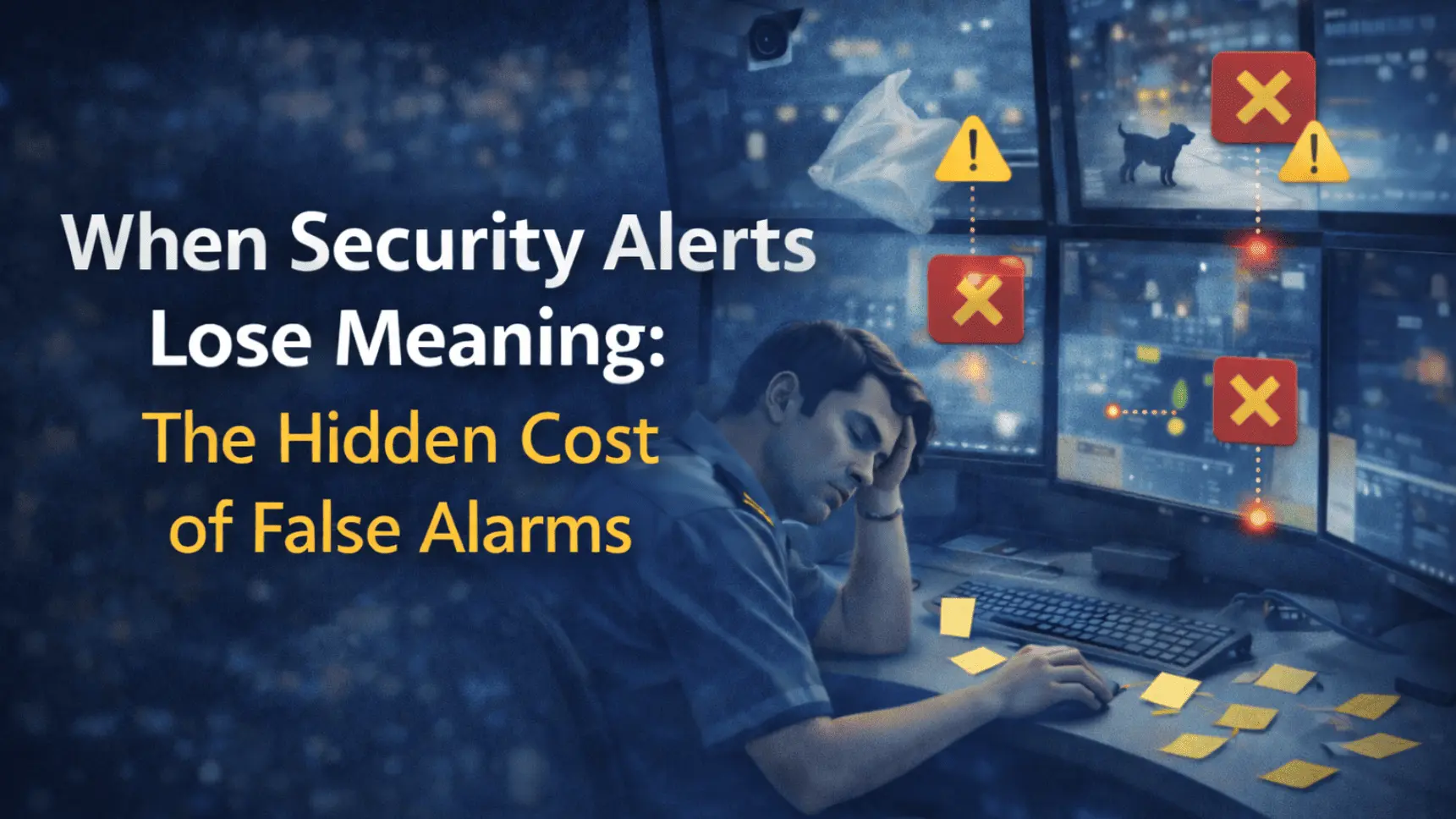
There is a specific sound that haunts a security control room. It isn’t the sound of a break-in.
It is the monotonous beep of a motion detector triggering for the four-hundredth time in one shift.
The guard looks up. It’s a plastic bag blowing across the lot. Ten minutes later, another beep. A stray dog.
Twenty minutes later. Headlights sweeping the fence.
By 3:00 AM, the guard stops looking. He hits "acknowledge" without checking the monitor.
At 3:15 AM, when a person actually cuts the fence, the system beeps again.
The guard hits "acknowledge." He doesn't look. The breach is missed.
This isn't laziness. It is security alert fatigue. It is the single biggest operational failure in physical security, and it happens because legacy systems are training operators to ignore them.
The Mathematics of Apathy
Traditional Video Motion Detection (VMD) is technically accurate but operationally useless. It detects pixel changes. To a VMD algorithm, a spider spinning a web over the lens is identical to a thief climbing a fence.
If your facility generates 500 alerts a night, and 495 of them are CCTV false alerts, your system has a 99% failure rate.
No human being can maintain focus on a task with that failure rate. Eventually, the brain tunes out the phantom triggers.
We often worry about physical blind spots—like those caused by obstructions (a risk we discuss in our guide to Camera Tampering Detection). But invalid alerts create a psychological blind spot. The operator sees the warning, but they’ve been conditioned to believe it implies zero risk.
Why "Rules" Don't Work
Legacy systems rely on "tripwires." You draw a line on a screen; if pixels cross it, an alarm sounds.
In a boardroom, this sounds logical. In a real logistics hub or plant, it fails. Trees sway. Tarps flap. Steam vents release pressure. False alarms in surveillance systems explode because the rules are too rigid for a chaotic reality.
I have audited control rooms where audio alerts were permanently muted because the constant pinging was driving the staff crazy. At that point, you don't have security. You just have a recording device for the insurance claim.
Context is the Cure
The solution isn’t higher resolution. It’s better filtering.
This is where AI surveillance accuracy separates itself from simple motion detection. We have to move from asking "Did something move?" to "Did something matter?"
Intelligent alert filtering requires context. It distinguishes between:
 A person walking past the perimeter (irrelevant).
- A person crossing into the perimeter (critical).
When we deploy Marwiz Vision Core Solutions, we aren't just installing detection. We are installing a silence filter. We are buying back the operator's attention span.
If we reduce 500 nightly alerts to the 5 that actually matter, the operator will check those 5. Every single time.
Real-World Proof: Silence is Value
The value of an AI-based surveillance alert system is measured in silence.
We recently audited a site where the legacy system flagged every forklift movement as a breach. By implementing specific object recognition - distinguishing authorized workers from unknown intruders—we killed 90% of the noise.
You can see the operational data in our Case Studies Page. The metric that mattered wasn't the number of captures; it was the massive reduction in null events.
The Cost of Noise
There is a hard cost to false positives in video analytics.
Every false alarm requires time to verify. If a guard spends 2 minutes checking a ghost alert, and that happens 30 times a shift, you lose an hour of productivity every night.
Worse, if a real theft is buried inside a stack of 50 wind-triggered alerts, and the operator mass-clears them, the liability sits with you.
Restoring Credibility
Moving to context-aware security alerts is a shift in philosophy. It acknowledges that human attention is a finite resource. You cannot waste it on shadows.
When a security officer trusts their screen, they react. When they don't, they hesitate. In security, hesitation is where the damage happens.
This same principle applies to compliance. If your system can be trusted to distinguish a thief from a tree, it can be trusted to distinguish a worker from a safety hazard. Reliable detection is the foundation of site safety—a concept we explore further in our insights on PPE and Safety Gear Detection.
Ready to get started?
Are you exploring your digital signage project needs (software and content)? Looking for just the digital signage display software or a full-scope proposal? Interested in a custom software solution tailored to your specific requirements? Would you like a personalized software demo?